
More There to See
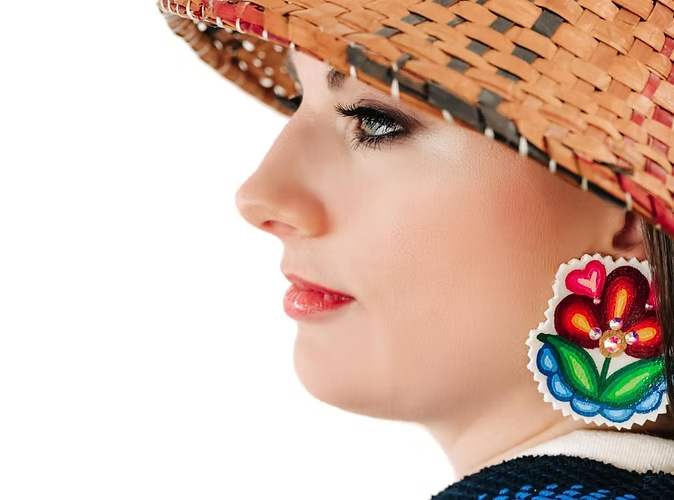
There are people in this community who show up so fully, so consistently, that you stop noticing how much they're carrying — until they write something like this and you realize how much they've been quietly holding.
Katy Carson is Métis, and she is one of the people I trust most in this work. She's been part of this community long enough that I sometimes forget not everyone knows her story the way I do. And this week, she reminded me that that forgetting — however well-meaning — is its own kind of thing to sit with.
What she's written here is honest and generous. I hope you read it slowly.
Not long ago, I was presenting a webinar alongside Kim and George when a question came forward from the audience: how do you navigate Indigeneity when you are white-presenting?
I sat with that for a moment. Not because I didn't understand the question but because I understood it too well.
I've been thinking about it a lot since. I think the answer comes down to this: you can't hide what you genuinely carry.
Recently, I had the honour of being blanketed in the Stz'uminus Longhouse – the home of my shuyulh, Wholwolet'za – at the closing of our experiential workshop. The ceremony was a surprise to those being honoured and it was not only my first time being blanketed, but my first time experiencing a blanketing ceremony.
I didn't grow up in culture. I'm still learning about Métis ceremonies, still finding my way in traditions I wasn't raised with. So being welcomed into this Coast Salish ceremony felt like something more than an honour – it felt like being invited in. Like belonging.
I struggle sometimes with feeling Indigenous enough. I recognize the privilege my white-presenting face affords me in non-Indigenous spaces, but that same face can make people wonder about me in Indigenous spaces. I catch myself looking for ways to signal, quietly, I'm one of us. I belong here.
And in that moment, I felt like I did, standing in a beautiful line of gratitude, people hugging me, shaking my hand, telling me they appreciated the work I do — when one of the Indigenous folks in the line smiled warmly and thanked me for being "such a great ally."
A small thing. They couldn't have known. They meant it as a compliment. It didn't feel right to correct them in that moment, so I smiled, and the line moved on.
But it stayed with me.
I do advocate for Indigenous people, educate settlers, support my community and represent them in various forums. I offer myself as a resource, and sometimes my white-presenting face actually makes it easier for people to ask me the hard questions. That work is real and I claim it. But it isn't the whole of me and the assumption of allyship left no room for the rest.
What made it land the way it did was where I was standing. This was a Culturally Committed space. I was surrounded by people who know me, who know my heart, who have never once questioned where I belong. I wasn't braced for it. I didn't think I needed to be.
That bracing — I know it well. I feel it when I walk into unfamiliar spaces, with people who don't have the context, who will see my face before they see anything else. The quiet preparation for having to explain myself. The expectation.
I carried a little of it with me at a recent workshop, when I approached an Indigenous speaker after her talk – the kind of talk where you find yourself nodding along not because you're being polite, but because something in it keeps landing true. She didn't know me. She didn't have the context. I went up to introduce myself in my good way, which of course includes my Métis identity. I was prepared for surprise.
She smiled and said, "I knew you were part of community. You were nodding along too much not to be."
She wasn't looking at my face and doing the math. She was watching how I listened. She didn't need the context, because she was paying a different kind of attention entirely.
We carry our identities in our bodies. In the way we go still when something resonates. In what makes us lean forward, what makes us exhale. In the nod that isn't performance — it's recognition.
You can't hide what you genuinely carry. It shines through.
To the person who called me an ally, I share this with no ill will. I deeply appreciate your warmth and encouragement. You saw something real. This is just a reminder that there was more there to see.
We don't always look the way you expect us to. And those of us who don't are quietly reminded of that more often than you might think, often in the very spaces where we should feel most at home. I carry my identity whether or not it's visible to you. I shouldn't have to wear my sash to prove that I belong.
But I'm learning to trust that it shows anyway, in the ways that matter, to those who are paying attention.
And to anyone sitting with that question from the webinar, to anyone who has ever wondered if they are Indigenous enough, visible enough, legitimate in the spaces that should feel most like home:
Surround yourself with people who know you and know your heart. Let them be your anchor.
Your people know who you are.
~ Katy Carson

I am so grateful to Katy for trusting us with this. For writing something so personal and so precise — for finding the words for an experience that so many people carry without quite being able to name.
If this landed somewhere in you, I hope you'll sit with it for a moment before moving on. And if you know someone who is quietly navigating the question of whether they are enough in the spaces that should feel most like home — maybe send this to them.
Your people know who you are.
🧡 Kim + the CC Team


Comments